
Brass Jewelry Manufacturing Steps From Casting to Packing
A brass order moves through eight documented factory operations between the sketch and the shipping carton, and only three of them carry a published clock. TTT Jewelry times 3D CAD at 3–4 weeks of production on top of a 25–30 day sampling window and 48-hour CAD, on a minimum of 100 pieces per design for artisan eco-brass. This is the sequence, in order.
Key takeaways
- Eight steps run from concept design to delivery, and 100% inspection happens before packing, not after.
- Only three steps are timed publicly: CAD under 48 hours, sampling 25–30 days, production 3–4 weeks.
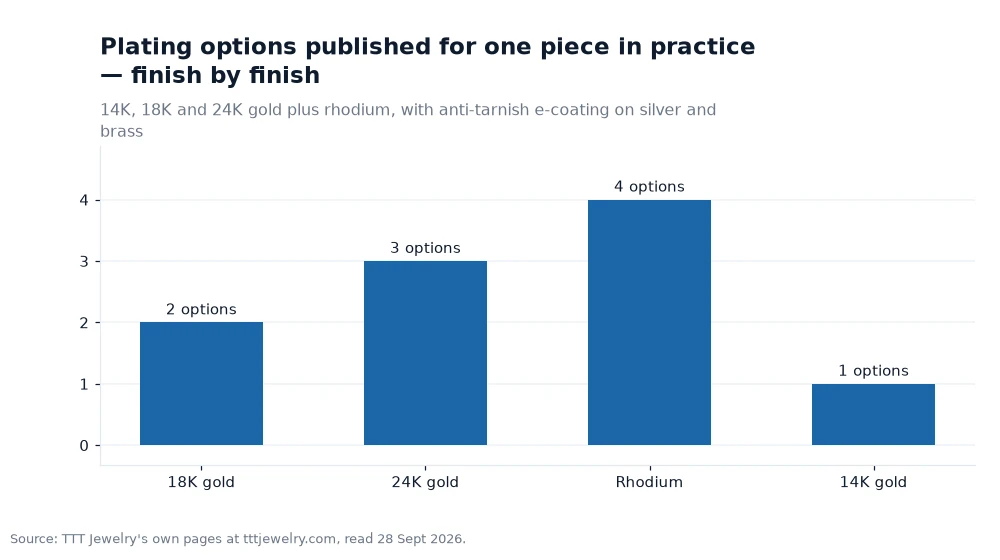
- Brass carries an anti-tarnish e-coating over multi-layer gold or rhodium plating, at 100 pieces per design.
- REACH compliance covers lead, cadmium and nickel, alongside ISO 9001:2015 and a BSCI social audit.
The eight steps in the order they happen
Concept design comes first, by hand and in CAD. Prototyping follows, by mould or by 3D printing depending on the shape. Then sprue cutting removes the feed channels left by casting. Polishing brings the surface to a high-gloss finish, and surface art adds the brushed or textured work that gives a piece its character. Electroplating puts the colour on. Final inspection checks the batch, and delivery ships it.
That list is more useful than it looks, because it answers a question a price list cannot: which stages the factory actually owns. If a supplier can describe the sprue cutting stage and explain why polishing comes before plating rather than after, the work is being done in-house. If the answer is a shipping date and nothing else, you are buying from a reseller.
Why casting and printing are two different steps
Prototyping is listed twice in one line for a reason: mould making and 3D printing solve different problems. A mould suits a design that will be repeated many times and needs consistent dimensions, while a 3D print produces a wax model for a shape whose geometry has not been signed off yet. A design with an unusual curve usually reaches the bench as a print before it reaches tooling.
This is also where a gold plated brass jewelry wholesale brief tends to go wrong. A buyer sends a photograph of a finished piece and expects it to be cast directly, without realising the order is being placed for custom brass jewelry. What actually happens is a CAD model, an approval on dimensions, then a wax print of that model, then a mould — and each of those is a place where the piece can be changed for less money than it costs later.
Polishing, surface art and the plated layer
Polishing and surface art sit next to each other in the sequence, and the order matters. A brushed or textured surface is applied after the high-gloss pass, before plating, because the metal underneath is what the texture is cut into. Plate a piece first and the texture has to be cut through the coating.
The same logic explains why plating comes seventh of eight rather than earlier. Everything abrasive in the process has to be finished before the piece meets the tank; the only operations that follow are inspection and packing. Any grinding, filing or heavy cleaning after plating is a repair, and repairs on a coated surface are visible.
| Step | What happens | Why it matters to a buyer |
|---|---|---|
| Concept design | Hand drawing and CAD model | The last cheap moment to change a shape |
| Prototyping | Mould casting or 3D printing | Decides whether the geometry is repeatable |
| Sprue cutting | Feed channels trimmed from castings | Signals whether casting happens in-house |
| Polishing | High-gloss surface before plating | Sets how smooth the plate looks |
| Electroplating | Multi-layer gold or rhodium, then e-coating | The colour the customer actually sees |
Inspection and packing at the end of the line
Final inspection is a documented step rather than a courtesy, and 100% inspection means every piece is checked rather than a sample of the run. Packing then carries the branding: display cards with backing, labelling with barcodes, velvet/microfiber pouches, foil-stamped boxes and a metallic logo tag are all listed as customisable packaging items.
For a small brand the packing decision is usually made too late. A foil-stamped box with a printed backing card sets a minimum quantity of its own, and if the packaging supplier's lead time runs past the jewelry production window, the finished pieces sit in the factory waiting for boxes. Order the packaging in the same message as the jewelry.
Six order stages, eight shop-floor operations
The brass line page groups an order into six stages: requirement confirmation, CAD design with a high-precision mould, prototyping and hand polishing, high-standard electroplating with an anti-tarnish finish, sample confirmation, then full inspection and packing. The factory page splits the same work into eight shop-floor operations. The two lists count the same production at different granularity, and either one works as a checklist.
The stage worth reading twice is the last one. Manual inspection on this line covers craft, finish, gem setting, size and structure — five separate judgements on each piece — before jewelry-specific packaging and trackable shipping. If a batch is going to fail, it fails one of those five, and naming them turns a quality conversation into something concrete rather than a matter of taste.
Worked example: how much of the process is on a clock
Eight steps are published; three carry a public duration. Three divided by eight is 3 ÷ 8 = 0.375, so 37.5% of the process is timed in public and the remaining 62.5% — sprue cutting, polishing, surface art, inspection and packing — has no published window at all. On a first order that invisibility is not a problem, because the sampling and production windows dominate the calendar.
Turn it around for the second order. Once the mould exists, the CAD stage disappears from the schedule and sampling shrinks to a colour or finish approval, so the two largest published blocks are gone and the untimed steps become the whole risk. Ask for a written step list with named owners before a repeat run, not before the first one, because that is when the invisible 62.5% starts deciding your delivery date. The arithmetic is mine; eight and three are the published counts.
Frequently asked questions
How many steps does a brass order actually go through?
Eight documented steps: concept design, prototyping, sprue cutting, polishing, surface art, electroplating, final inspection and delivery.
Which step takes the longest?
Master sampling, quoted at 25–30 days, ahead of mass production at 3–4 weeks; 3D CAD is the fastest at under 48 hours.
Is every piece inspected before it ships?
Yes. Final inspection is listed as 100% inspection of the batch and happens before packing and delivery, not after.
Reading a step list like a buyer
Ask for the sequence in writing and count how many stages are named. A factory that lists sprue cutting and surface art is describing a floor; one that lists design, production and shipping is describing a sales funnel. Then map the three published durations onto the steps and see which ones are left open, because the open ones are where a repeat order goes sideways. Published floors are 100+ in stainless steel, 50 pcs in 925 silver and 100 in artisan brass, counted per design, applied design by design. A stainless version of the same design runs through PVD vacuum plating instead of a wet tank, which the stainless steel line sets out, and the full sequence is documented on the factory walkthrough.
The published detail behind this piece — the REACH and Prop 65 statements along with the master sample rule plus the recyclable-brass statement — sits on the maker's own site at tttjewelry.com, checked 28 Sept 2026. MOQ by material is set out on those pages. Nothing else here is inferred. The restating of the windows is mine alone — the site supplies the inputs only [1]